WhatsApp Business API Pricing Explained for 2026
• Written by Younès Benallal
Navigating WhatsApp Business API pricing has changed significantly. As of July 2025, Meta moved from conversation-based pricing to a per-message pricing model. With over 3 billion users worldwide, WhatsApp has become essential for businesses.
Yet, understanding its pricing structure can feel like decoding a cryptic message. This article breaks down WhatsApp's per-message pricing, free messaging opportunities, volume discounts, and the latest 2026 rate updates so you can budget accurately for your business communications.
Overview of WhatsApp Business API Pricing
The WhatsApp Business API lets companies communicate with customers at scale. Unlike the free WhatsApp Business App, the API offers advanced features for larger operations. However, this enhanced functionality comes with a price tag.
Per-Message Pricing Model
Since July 1, 2025, WhatsApp Business API uses a per-message pricing model. You are charged for each delivered template message, not per 24-hour conversation window. Costs depend on the message category (marketing, utility, authentication, or service) and the recipient's country code. Non-template replies within a customer service window remain free.
Message Categories
There are four main message categories:
- Service
- Marketing
- Utility
- Authentication
Each category serves a different purpose and comes with its own pricing rules. For example, a marketing template promoting a new product costs differently than a free-form reply inside a customer service window.
Want to see how businesses are leveraging these different message categories? Explore our comprehensive guide on WhatsApp API use cases to discover real-world applications across various industries.
Regional Variations
Regional variations add complexity to pricing. A delivered template message to a customer in India might cost less than a similar message in the United States. This disparity reflects differences in market conditions and economic factors across regions.
Message Categories
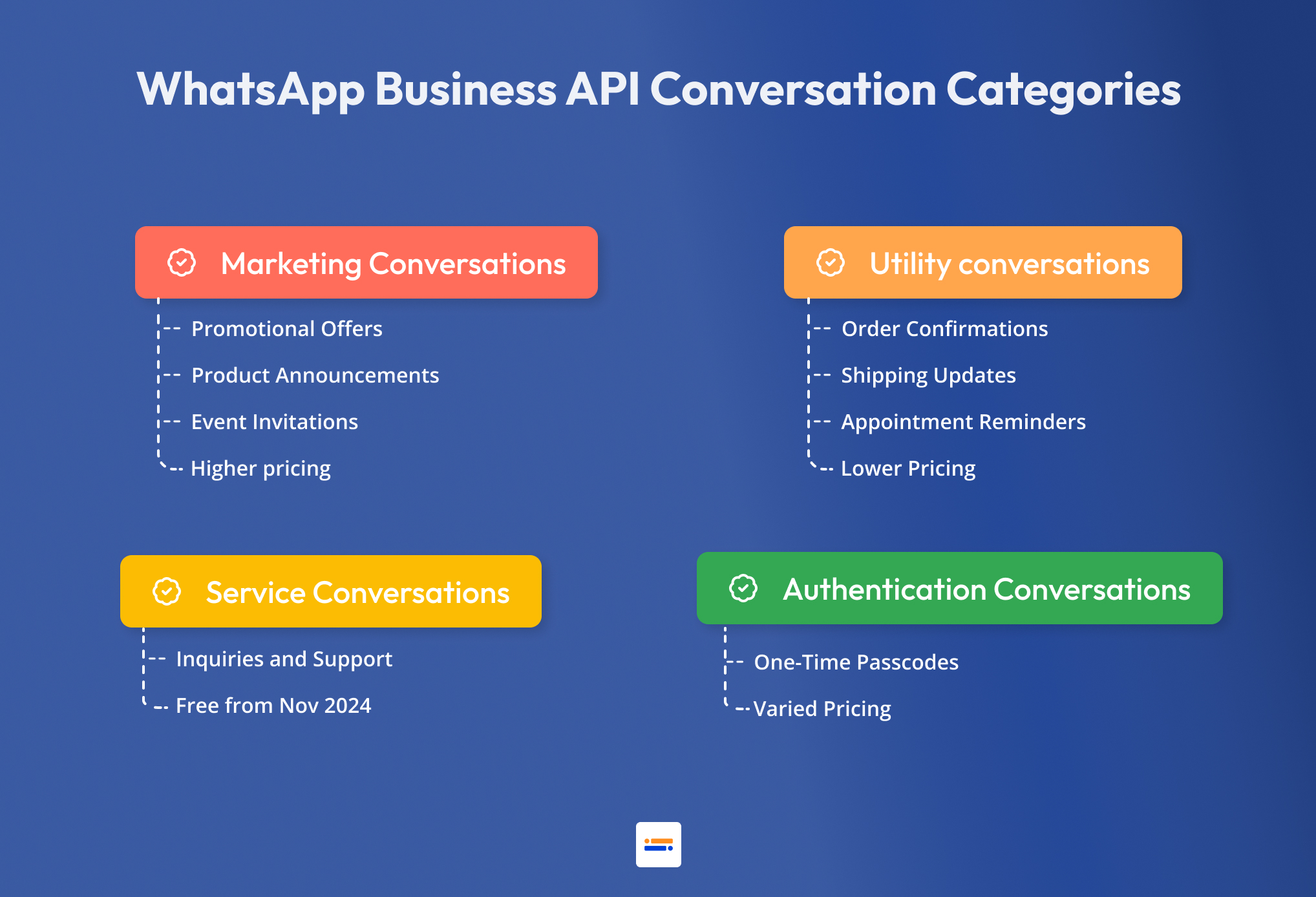
WhatsApp Business API categorizes template messages into several types, each with its own purpose and pricing implications. Understanding these categories helps businesses optimize communication and manage costs.
Message templates determine billing categories: marketing templates are billed as marketing, utility templates as utility, and authentication templates as authentication.
Service Interactions
Service interactions are user-initiated messages for inquiries, concerns, or support requests. Since November 2024, service interactions are free, replacing the previous model of 1,000 free service conversations per month.
This change aims to encourage customer-business interactions without financial barriers.
Marketing Templates
Marketing templates are business-initiated messages that promote products or services. They include promotional offers, product announcements, and event invitations. Pricing for marketing templates is higher due to their potential for driving business growth.
For example, in Saudi Arabia, a marketing message costs more than utility or authentication messages in the same region.
Utility Templates
Utility templates deliver transactional information like order confirmations, shipping updates, and appointment reminders. These business-initiated messages are often priced lower than marketing messages.
In India, a utility message is much cheaper than a marketing message in the same region.
Authentication Templates
Authentication templates involve security and verification. They include one-time passcodes (OTPs) for user authentication or transaction verification.
Pricing for authentication messages varies, especially for international authentication. In 2025, WhatsApp adjusted international authentication rates in several markets.
Categorization Process
Message templates determine billing categories:
- Marketing templates are billed as marketing.
- Utility templates are billed as utility.
- Authentication templates are billed as authentication.
User-initiated interactions are handled inside the service window. If a template combines utility and marketing content, WhatsApp categorizes it as marketing to avoid ambiguity.
To maximize the value of the WhatsApp Business API, align message types with your business objectives to manage expenses effectively.
WhatsApp Pricing Calculator
Navigating WhatsApp Business API pricing can be challenging, especially with country variations and different message types. To simplify this, we've developed an interactive tool that provides quick pricing estimates based on your specific needs.
How the Pricing Calculator Works
This pricing calculator lets you select your country and message type. It then displays the current list-rate estimate for that combination, giving you a clearer understanding of costs in your region.
Comparing Costs Within a Country
Using this calculator, you can compare message costs within your country. For example, in Brazil, a marketing message costs $0.0625, while a utility message costs $0.0068. This difference highlights the importance of categorizing messages correctly to optimize spending.
Understanding Regional Pricing Variations
The tool also helps with regional pricing variations. For instance, you might see that authentication messages in India cost $0.0014, while in Indonesia, they're $0.0250. This insight is valuable for businesses operating in multiple countries, aiding in accurate budgeting for WhatsApp communication strategies.
Staying Updated with Pricing Changes
While this tool provides current list-rate estimates, remember that WhatsApp Business API rates can change. Meta updates rate cards regularly, so check the official pricing page for the most up-to-date information.
Are you building a WhatsApp chatbot? We've put together a comprehensive guide to walk you through the process of creating your very own WhatsApp chatbot.
Pricing Structure
WhatsApp's pricing for its Business API is flexible to meet various business needs and market conditions.
Per-Message Pricing Explained
WhatsApp charges per delivered template message. You only pay when a template message (marketing, utility, or authentication) is successfully delivered to a user. Failed or undelivered messages are not charged. Each template message costs a fixed rate based on its category and the recipient's country code. Rates are determined by the recipient's phone number country code, not your business location. This model makes budgeting simpler — you can calculate costs based on message volume and audience geography.
Regional Variations in Pricing
WhatsApp's pricing varies significantly by region. Costs reflect market conditions, user behavior, and economic factors.
Utility and authentication messages are significantly cheaper, often 50–95% less than marketing rates in the same country. These differences mean businesses operating in multiple countries need to customize their WhatsApp strategy per market. A cost-effective campaign in one country could be expensive in another.
Sample Per-Message Pricing (Mid-2026)
Here's a look at per-message USD list rates effective April 1, 2026. Always verify on Meta's official pricing page as rates update quarterly:
| Country | Marketing | Utility | Authentication | Service |
|---|---|---|---|---|
| Brazil | $0.0625 | $0.0068 | $0.0068 | Free |
| India | $0.0118 | $0.0014 | $0.0014 | Free |
| United States | $0.0250 | $0.0034 | $0.0034 | Free |
| United Kingdom | $0.0529 | $0.0220 | $0.0220 | Free |
| Germany | $0.1365 | $0.0550 | $0.0550 | Free |
| Indonesia | $0.0411 | $0.0250 | $0.0250 | Free |
| Important note: Service is now free in all countries. Utility and authentication rates are often similar since WhatsApp simplified pricing. Some markets also have a separate Authentication-International rate (e.g., UAE, Egypt, Nigeria) for cross-border OTP delivery, which can be 3–18x higher than the standard auth rate. |
Insights from Sample Pricing
From the samples, marketing messages are the most expensive across all countries. However, the gap between marketing and other categories varies significantly by region. In India, marketing costs roughly 8x more than utility; in Germany, the ratio is closer to 2.5x.
Absolute price differences between countries are stark. A marketing message in India costs $0.0118, while in Germany it's $0.1365 — more than an 11x difference. This underscores the need to tailor strategies to specific markets.
Importance of Understanding Pricing Nuances
Understanding these pricing nuances is crucial for businesses. By carefully considering the types of messages and the regions they operate in, companies can optimize their use of the WhatsApp Business API for cost-effective and impactful customer communication.
To gain deeper insights into optimizing your chatbot strategy, be sure to check out our article on the best WhatsApp chatbots available.
Free Messaging Windows and Cost-Saving Opportunities
Understanding WhatsApp's free messaging windows is essential for controlling costs. Here are the three key ways to send messages without incurring charges.
The 24-Hour Customer Service Window
When a customer messages your business first, a 24-hour service window opens. Within this window, all free-form replies (text, images, files) and utility templates are free. The timer resets each time the customer sends a new message, so an active support conversation can remain free indefinitely.
What's free: Unlimited free-form text, images, videos, documents, and utility templates.
What still costs: Marketing templates and authentication templates sent within this window.
The 72-Hour Free Entry Point (FEP) Window
When someone contacts you through a Click-to-WhatsApp ad on Facebook or Instagram, or via a Facebook/Instagram Page call-to-action button, a 72-hour window opens where all messages are completely free — including marketing and authentication templates. This is one of the most powerful cost-saving features in the platform.
Smart businesses design entire lead generation and nurture sequences to operate within this window, turning ad spend into a zero-cost messaging channel.
Volume Tiers for Utility and Authentication
Meta offers volume-based discounts on utility and authentication messages. As your monthly volume increases, per-message rates automatically decrease:
- Under 10,000 messages/month: Standard rate
- 10,000–100,000: ~5–10% below standard
- 100,000–1,000,000: ~10–20% below standard
- Over 1,000,000: Custom enterprise pricing
Note: Marketing messages do not qualify for volume discounts. Volume tiers are calculated per WhatsApp Business Account (WABA).
Quarterly Rate Updates
Meta updates message rates on the first day of each quarter (January 1, April 1, July 1, October 1). Recent and upcoming notable changes include:
- July 1, 2026: Marketing rate increases in Italy, Spain, and the UK; transactional/authentication increases in Hong Kong, Hungary, Qatar, Romania, and Singapore; rate decreases in Poland.
- April 1, 2026: Marketing rate increases in India and Saudi Arabia; Authentication & Utility increases in Pakistan (~85%); major decreases in Turkey (>80%).
- January 1, 2026: Utility and authentication decreases in North America; marketing rate decreases in France and Egypt.
BSP Markups and Total Cost of Ownership
You can access the WhatsApp Business API directly through Meta Cloud API if you have developer resources. Many teams still choose a Business Solution Provider (BSP) or messaging platform for onboarding, dashboards, support, or extra tooling. When you do, those providers may add their own costs on top of Meta's base rates:
- Per-message markup: Some providers (e.g., Twilio) add $0.005–$0.010 per message on top of Meta's rates.
- Percentage markup: Others (e.g., WATI) add ~20% above WhatsApp's fees.
- Monthly subscription + passthrough: Platforms like Typebot charge a flat monthly fee and pass through Meta's rates at cost.
Total cost = WhatsApp per-message fees (Meta) + optional BSP markup + optional platform subscription
How Typebot Pricing Complements WhatsApp
Typebot pricing is separate from WhatsApp's own message fees. Here's how they stack together:
- Free plan: 200 chats/month — great for testing
- Starter ($39/month): 2,000 chats/month
- Pro ($89/month): 10,000 chats/month
- Self-hosting: Free (open-source) — you only pay server costs
Realistic monthly estimates:
- Low-volume (<1,000 chats or outbound messages/month): ~$39–$89/month total (Typebot + WhatsApp fees)
- High-volume: Typebot Pro + WhatsApp volume-tiered fees
- Self-hosting can eliminate Typebot subscription fees entirely.
Remember: WhatsApp per-message fees are paid to Meta or your BSP. Typebot provides the chatbot platform on top.
Cost Optimization Tips
- Maximize service windows: Route customer support through the free 24-hour window rather than sending outbound utility templates.
- Use Click-to-WhatsApp ads: Structure ad campaigns to trigger the 72-hour free entry point window.
- Classify templates correctly: Mislabeling a utility template as marketing can cost 5–10x more per message.
- Consolidate WABAs: Combine message volume under fewer accounts to reach volume tier thresholds faster.
- Monitor quarterly updates: Check Meta's rate card at the start of each quarter to avoid billing surprises.
- Optimize template CTR: Higher engagement means better ROI on per-message costs.